CIES 2026: EdTech innovations protect education for vulnerable children amid budget cuts

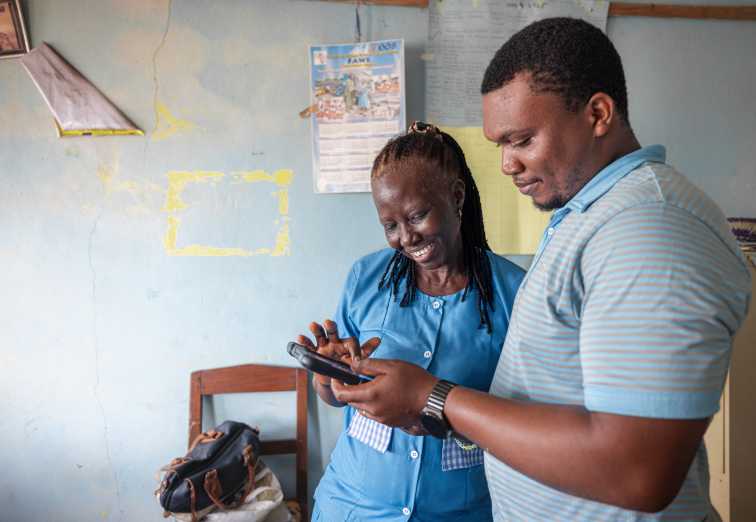
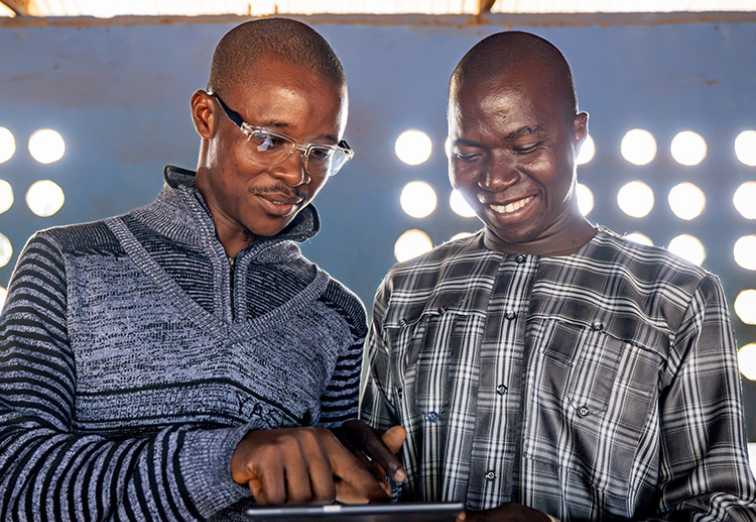
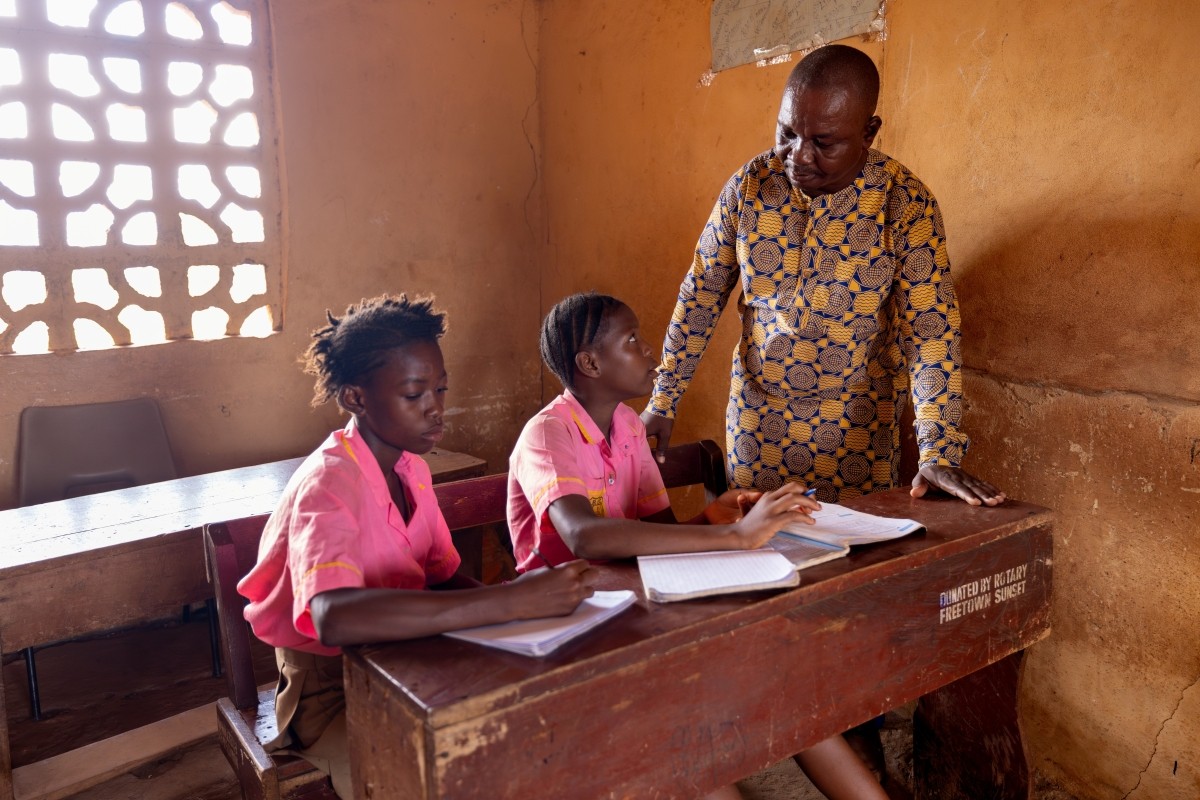
Teachers at the Rural Education Committee (REC) Primary School in Russel, Sierra Leone use the Wi De Ya education and attendance monitoring platform on a tablet.
This blog was written by Hannah Graham, Corus Senior Education Advisor, based on her presentation for the 2026 CIES conference.
Education stands at a critical juncture: funding is in freefall, with a projected $3.2 billion loss by 2026 — 24% less than 2023 — and the number of vulnerable and out-of-school children is at a record high, expected to rise from 272 million to 278 million by the end of this year.
Evidence shows that when budgets shrink, programs supporting children who are the hardest and most expensive to reach are cut first. Within the last year, hundreds of thousands of children have lost vital support that helps to keep them in school, and many more are at risk of losing access to education altogether.
How can we continue to reach these children with education as funding contracts? The answer lies in harnessing EdTech innovations.
Precision at scale
Reaching the most marginalized has always been more complex and expensive. These children who are out of school or at risk of permanent disengagement face compounding vulnerabilities — poverty, distance, disability, caregiving responsibilities — and no single approach reaches them all. Targeted design is essential.
But the technological and data barriers that once made targeting genuinely difficult have largely been overcome. Data-driven approaches, built on national digital infrastructure and delivered through coordinated stakeholders, are now capable of reaching vulnerable children with precision and at a scale that was previously impossible — and doing so within the national systems that already exist, rather than around them.
Reaching the most vulnerable requires knowing who they are, where they are, and what is preventing them from being in school. National systems designed to capture granular, real-time learner data provide something no standalone development program has ever been able to replicate: a complete, continuously updated picture of vulnerability at national scale. This data – when actively connected to schools, field staff, government and education partners – serves as a robust foundation on which targeted interventions can be built, scaled and then monitored.
This is exactly how Corus helps vulnerable girls to access and stay in school in Sierra Leone.
From broad-brush to targeted precision
The Corus-funded Girls In School Initiative (GISI) in Sierra Leone leverages existing Digital Public Infrastructure (DPI) to identify girls facing barriers to attending school and to target them to receive lightly conditional monthly cash transfers and personalized case management.
GISI also utilizes the government-owned national digital education system, called Wi De Ya. With Wi De Ya, the Government of Sierra Leone captures individual teacher and learner data in schools, such as daily attendance and demographic vulnerabilities, even in hard-to-reach areas, and analyzes it to make data-driven decisions to improve education delivery.
Data as a starting point
For Corus, this data is not just an operational tool, it was a starting point for program design. Analysis of the wealth of detailed data in Wi De Ya reveals which learners are most likely at risk of dropping out of school, informing initial targeting decisions. For example, data shows that overage girls are significantly over-represented among those at risk, and that girls with maternal status are twice as likely to miss school — with average attendance of just 51%. These girls, along with those with a reported functional disability, or those living with one parent or no parent, (all of which are reported in the Wi De Ya app) form our target GISI group.
Daily data, real-time response
Daily attendance reporting enables real-time tracking and early warning, flagging girls at risk of dropping out before absence becomes permanent. This allows case management (which is typically resource-intensive) to be targeted in a precise and timely manner — directed only at the girls who need it most, when they need it.
This data-driven targeting allows case managers to identify further barriers that may be preventing a girl from attending school and introduce wrap-around support from third-party services where needed.
The results are promising. Attendance rates in the treatment group are significantly higher than in the control group across all learners. Overage girls — among the most vulnerable — are more responsive to the cash intervention than younger girls. And critically, there are far fewer outliers — the girls with the lowest and most volatile attendance — in the treatment group than the control, suggesting the program has a stabilizing effect on those whose personal circumstances make their attendance most precarious.
System strengthening as a by-product, not an add-on
Perhaps the most significant finding is what happens to the system around the program. Digital public infrastructure provides detailed, timely, reliable data on which to build, while removing the need to fund and roll out separate data‑collection projects — creating critical efficiencies when resources are constrained. The benefits extend well beyond the program itself: before the system was introduced, fewer than 50% of teachers and officials felt comfortable with digital hardware; afterwards, that figure rose to over 94%. Digital literacy becomes not a precondition for participation, but a consequence of it.
These shifts demonstrate what system strengthening looks like when it is “baked in” rather than “bolted on.” The system doesn’t function as a parallel, project‑driven data infrastructure that disappears when the program ends. Instead, it enables lasting behavioral change: 65% of education officials report reviewing the data dashboard three to five times per week, showing that the data is not just being collected—it is actively used by those with the proximity and authority to act on it. The result is a strengthened national system that continues to function — and improve — long after the program has moved on.
The remaining barrier — and what to do about it
The technology now exists to ensure an open flow of data from and resources to hard-to-reach schools, but this remains rare in sub-saharan Africa. What is needed now is that Education Management Information Systems (EMIS) are fit-for-purpose. They must to be designed around the daily, disaggregated data that not only makes targeting possible but is already used daily in schools – digitally or not - rather than the annual census snapshots and aggregated figures that all too often remain the norm.
When Ministries of Education have access to this frequent, detailed data, they use it. And development partners can leverage the same data to design and target programs with far greater precision and at a scale that parallel, project-based systems can’t sustain.
Now is the time to act
The education funding crisis is real, and its consequences for the most vulnerable children are already being felt. But the response to contracted funding cannot be a retreat to the easiest-to-reach.
The EdTech tools exist, and the evidence is clear. It is time for governments, donors, and education leaders to prioritize data-driven systems that generate the evidence required to ensure that no child is left behind. And as education partners, we have a duty to reinforce these efforts in our own programming.
Corus company CGA Technologies developed the HereMIS education system for which Wi De Ya (We Are Here in Krio) is the Sierra Leonean name. Learn more about HereMIS: