The case for scaling education data in the DRC


Good education data systems are essential. Yet building systems that last has often proved elusive. Many fail — not because the technology is wrong, but because the institutional foundations needed to sustain them were either missing or not effectively integrated into their implementation. Research spanning six countries found that education data is rarely maximized even when available. The Global Partnership for Education describes it plainly: countries keep struggling with the same data problems despite the investment.
The result is often expensive, underused platforms that absorb funding without delivering change. The cost is not only financial. Each year that a system stalls, education decisions are made without the information needed, including decisions about budgets, examinations and allocation of resources that determine whether children reach their learning potential.
The Democratic Republic of Congo (DRC) is different — the national institutional foundations already exist, but progress is now at risk without urgent investment.
The institutional foundations are already there
In many contexts, particularly in sub-Saharan Africa, building a functional digital data system that manages information on individual learners means starting from scratch: securing political buy-in, training a workforce, establishing data collection processes, and embedding new functions into government structures. In the DRC, much of that work has already been done.
SERNIE, which is the government department responsible for individual learner data under the DRC’s Ministry of Primary, Secondary and Technical Education (MEPST), has a nationwide mandate, a decentralized workforce and established processes for collecting, managing and reporting learner records. This is because SERNIE recognizes that this data is critical for the government to plan, manage and deliver essential education services.
For decades, SERNIE staff have visited schools directly, registered learners, maintained enrollment records and produced the official data underpinning national examination planning. This is not a new function being bolstered by a development partner; it is an existing government operation, delivered at scale, across the country. It is a function that, in many ways, would be the envy of many countries in the region.
However, since its creation in 1991, SERNIE teams have carried out this mandate using paper forms, physically transporting them to Kinshasa for centralized data entry. The result is processing delays long enough to render data outdated before it could even be digitized or used. For time-critical processes like national examinations, learner data arrived too late to be reliable, and, despite the best efforts of SERNIE teams, came to be seen across the education sector as inaccurate and irrelevant.
A nationwide workforce, performing a nationally mandated function, was being held back by paper.
For many years, SERNIE has been responsible for identifying learners and maintaining official school records, but the limits of paper‑based processes have made this work slow and difficult to use for wider planning.
What digitization makes possible
EDUSER is a digital enrollment system developed with technical support from Corus company CGA Technologies. The system was designed to solve this specific problem. Rather than replacing or reimagining the work that SERNIE does, it enhances it, by enabling SERNIE to deliver its existing mandate in line with MEPST's 5-year education sector plan but without many of the logistical roadblocks.
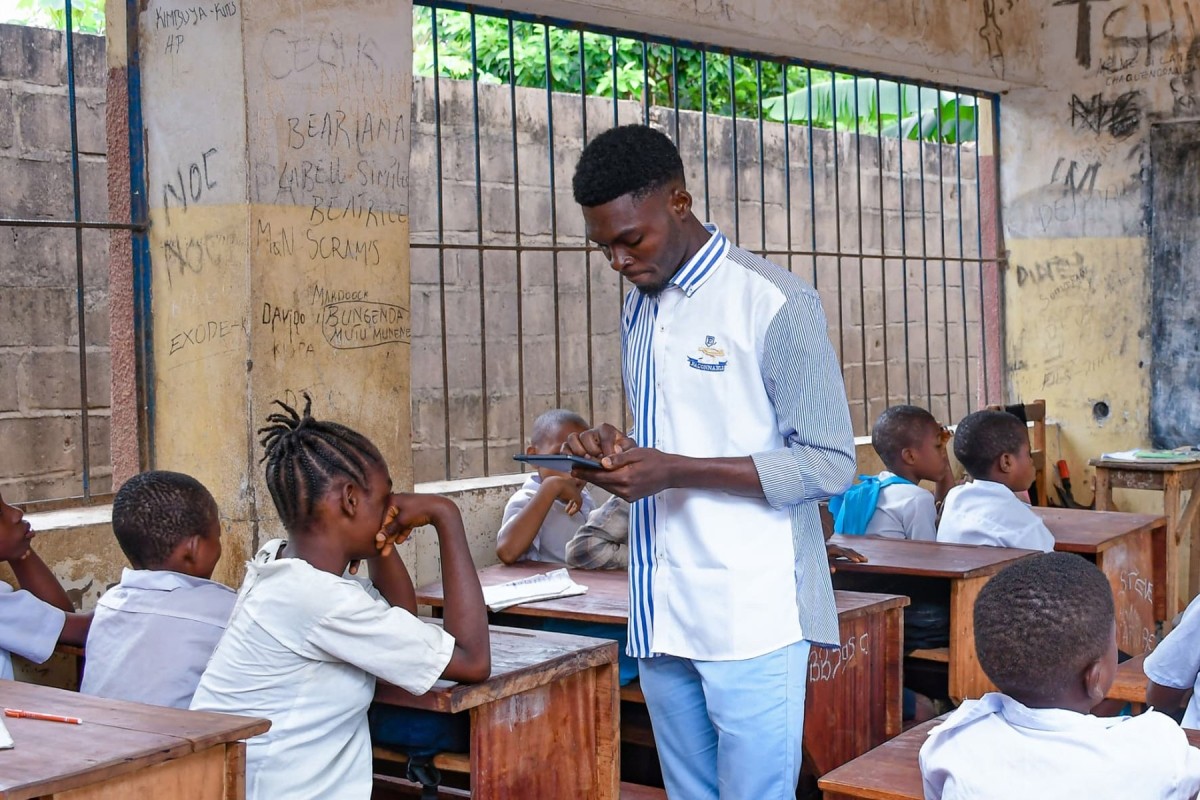
The system replaces paper-based data collection and a process that duplicates – or even triplicates – efforts with app-based registration carried out by SERNIE's own staff during their existing school visits to manage and support education quality. Learner data, including government-issued IDs, demographics (age, sex, disability status, maternal status) and class level, is captured directly at the local level and processed without the delays that centralized data entry created.
The practical gains are immediate:
- Timely enrollment records are available for national examination planning for the first time.
- Individual learners are now tracked across school transfers and year-on-year enrollment.
- Disaggregated data builds a richer picture of who learners are and what they need, enabling more targeted planning across the education system.
In essence, it delivers more education data, faster and with less effort.
Another education monitoring platform developed by CGA Technologies, called HereMIS, provided the building blocks for EDUSER and was adapted to fit SERNIE's operational reality. Ownership and use of the system remain with the DRC’s Ministry of Education.
Understanding not only how many learners are enrolled in public schools, but who they are, what they need and whether they are being retained and progressing over time, is a prerequisite for effective education planning and management. In the DRC, authorities have prioritized this work within one of the largest and most complex education systems in sub‑Saharan Africa, despite persistent resource constraints.

Why this data matters beyond exam planning
Reliable individual learner data has value well beyond SERNIE's core function. Other education departments in the DRC collect data on teachers and school infrastructure separately. With accurate, detailed enrollment data in place, it becomes possible to improve teacher deployment, which aligns education supply with demand, reduces duplicate data collection across departments and supports closer coordination across the education system as a whole.
For external partners and donors, EDUSER data offers a consistent, government-owned foundation for targeting interventions and reducing the need for parallel data collection efforts that fragment resources and undermine government systems.
Testing under real conditions
In April 2026, SERNIE teams completed the first test of the system in DRC schools — a 3-week EDUSER pilot across 20 primary schools in Kasai Province. Using a cascade training model, SERNIE staff at national, provincial and local levels were trained before collecting data directly in schools.
The results confirmed what the system was designed to deliver. Across 20 schools, SERNIE teams registered 8,634 learners (4,509 girls and 4,125 boys) using their existing workforce and established processes, with data available for national examination planning for the first time.
Among those registered, 11 girls were formally identified as mothers or pregnant and 14 children were recorded as having a disability. Both are groups who would previously have been invisible to authorities, not showing up in paper-based records and more likely to disappear again unnoticed. The pilot also captured linguistic diversity across classrooms, surfacing a significant factor that affects teaching quality and learning outcomes – something that no previous system had recorded at this level.
User feedback from the pilot reinforced these results. SERNIE teams reported that the system was highly usable in practice, well adapted to their operational context and processes, and provides the data they need to carry out their mandate. The main challenge identified was synchronizing data in settings where internet bandwidth is even more limited than anticipated. Technical solutions are now being put in place to ensure the system, which is already designed to work online and offline, is even more robust in these contexts.
This level of data is what is needed for decision makers to understand what the demand on education services looks like and how to better manage their delivery. The pilot confirmed that reliable, timely learner data is not only essential in the DRC, but achievable through existing government structures. It also established the foundation for a national rollout.
A decision point — and a case for investment
The pilot was funded, but its future is not. Without continued investment, a system with great potential for at-scale impact and built with the right foundations — government‑owned, delivered by a national workforce, embedded in established processes, and designed to generate the learner data decision-makers need most — risks becoming another unfinished investment in an already overstretched sector.
The case for continued funding rests on what makes EDUSER different:
- The foundations are already in place. SERNIE already has the mandate, workforce and processes to collect learner data nationwide. EDUSER is a proven government-owned tool that enables this long-established government team to strengthen the work it is already doing.
- Scaling unlocks impact. Rolling EDUSER out nationally will give the DRC, for the first time, timely and reliable individual learner data at scale, enabling the government to track children through the education system and plan resources where they are needed most. It will also build national capacity to sustain digitization independently in one of the world’s most under-resourced education systems.
- The cost of inaction is concrete. The DRC has approximately 35 million school-age children, of whom an estimated 7.6 million are already out of school, yet the system still lacks reliable individual learner data to track them. Without the information it needs to act, the government cannot make decisions that drive progress, retention and learning outcomes, deepening an already spiraling out-of-school crisis.
We hope this does not stop here and that we can continue moving forward because this is only the pilot phase. Kasai is the starting point, but in the long term, these systems should reach the whole country. If we stop in Kasai, we will not have achieved much. This system will strengthen student identification, improve data traceability, and support educational planning across the country.
Caution in funding digital systems is understandable and, in many contexts, warranted. Where institutional foundations do not exist, the risks and costs are higher, and the sector's track record bears this out. Corus' own framework for sustainable EdTech investment identifies the sequencing of foundational systems before classroom technology as the critical determinant of success or failure. But caution applied uniformly, regardless of context, means passing up the cases where success is genuinely within reach.
The DRC is one of those cases. The question is whether someone will choose to support it.
ENDNOTE:
EDUSER was developed with the technical support of Corus organization CGA Technologies and funded through the £23million FCDO-funded Accès et Égalité pour l’Éducation des Filles (AXE‑Filles) program.
The Axe-Filles program, which began in March 2023, aimed to increase girls’ access to education in Kasai, one of DRC’s most disadvantaged provinces, including strengthening national education data systems through the digitization of SERNIE’s learner enrollment processes. Originally planned to run for 5 years, Axe-Filles closed early as a result of funding cuts.