The 2021 Early Warning Forecast
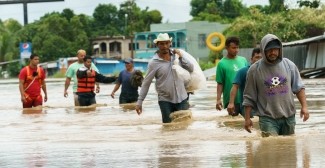
Fire crews help evacuees through rushing water in Jerusalem, Honduras after Hurricane Iota. Photo by Gregg Brekke for Corus International.
Responding to compound disasters in a context of conflict and fragility
By Ambassador Daniel V. Speckhard, President & CEO, Corus International
The COVID-19 pandemic made evident the increasing reality that disasters — man-made due to conflict or natural — do not happen in a vacuum, and that a community rarely has the luxury of only facing one emergency at a time. Humanitarian organizations must now routinely respond to compound disasters, multiple crises occurring simultaneously or overlapping one another; some sudden impact as in an earthquake, and others happening over months or years.
By definition, every emergency Corus International responded to in 2020 going into 2021 was a compound disaster, with COVID-19 layered on top of all other calamities. Several of our development and health programs found they needed to pivot some of their resources to respond to the health and economic impact of the coronavirus. But even before the pandemic, we found that we had to respond to multiple crises that called for a range of skills and a holistic approach. Some of these disasters have independent origins, and others are cascading, with one disaster begetting another. Global trends — such as climate change — have unique local manifestations which play out in different ways.
Increasingly we find that the world’s most vulnerable people live in fragile settings marked by armed conflict — another global trend — making a humanitarian response more complex and dangerous. In addition, the number of disasters caused by natural events has doubled since 1980, with climate change often accounting for both the increase in frequency and the greater intensity of these crises. Among other factors in the compounding of disasters is the increasing concentration of population due to urbanization.
Corus International responded to several major compound disasters in the last year:
- In our recently concluded successful response to Ebola in the Democratic Republic of Congo, our clinics, health workers and facilities were attacked by militias, resulting in damage and death. But our IMA World Health staff and partners continued to respond.
- Central America has struggled with several factors that are driving forced migration, including the effects of climate change on the livelihoods of farmers, high levels of violence perpetrated by criminal gangs and widespread political corruption. Add to these an especially heavy COVID-19 toll and the destruction of hurricanes Eta and Iota.
- Lebanon was experiencing the worst economic crisis in its modern history when its capital city of Beirut was rocked by devastating explosions, a disaster that exacerbated the spread of COVID.
Addressing these complex emergencies will require responses, as well as preparation through disaster risk reduction initiatives, that are multifaceted and holistic, bridging sectors such as health, agriculture, livelihoods and technology for development. The latter is promising, but we still have a lot of work to do. As we have seen with the response to COVID-19, many of our processes have gone digital, including impact data collection, access to information, training and other functions. The lack of access to technology and its penetration in some of the world’s developing and poorest countries further creates a divide that will be difficult to bridge.
As we face these challenges, we offer this Early Warning Forecast for 2021, which highlights 10 continuing or worsening humanitarian emergencies that we believe will require urgent attention in the next year. This list is not comprehensive but singles out those specific crises or issues that will have ripple effects well into the coming years.
Yemen
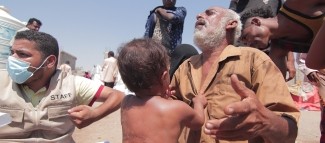
Omar Mohamed with his daughter, who was injured in an airstrike, at a displacement camp in Aden, Yemen. Photo by Ali Saleh for Corus International.
For the third straight year, war-torn Yemen leads the Early Warning Forecast as the world’s worst humanitarian disaster. It has suffered through six years of constant conflict between the government, supported by a Saudi-led and U.S.-supported coalition, and the opposing Iran-backed Houthi militias, which control much of the country, including the capital. The war has killed more than 233,000 people, including 131,000 from indirect causes such as disease, hunger and inadequate health infrastructure.
Nearly 80 percent of the population — over 24 million people — require some form of humanitarian assistance and protection. Over the past year, more than 25,500 families have been forced to flee from their homes, driven by war, flooding and the COVID-19 pandemic. Only about half of the country’s health facilities are functioning, and those face critical shortages in staff and medical supplies. violence against women and girls has risen by 17 percent.
More urgently, famine looms. The economy has collapsed and the local currency has been severely devalued. Adding to the country’s woes, swarms of desert locusts have inflicted heavy crop losses on Yemeni farmers.
”Yemen is now in imminent danger of the worst famine the world has seen for decades. In the absence of immediate action, millions of lives may be lost,” United Nations Secretary-General António Guterres said in late November.
Response: Corus International is working to improve the health of conflict-affected communities in Yemen through projects focusing on waste management and providing safe and clean water.
Latin America: The heavy economic and health toll of COVID-19
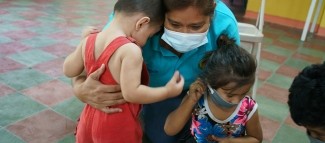
Daisi Barena Alverengi works with children staying at a shelter in Suyapa, Honduras following Hurricane Eta, where the lack of social distancing increases the risk of COVID-19. Photo by Gregg Brekke for Corus International.
While COVID-19 has caused fear, suffering and death around the world, the pandemic has taken an especially heavy toll in Latin America. As of September, the Latin America and Caribbean region, which represents just 8 percent of the world’s population, accounted for one-third of global COVID deaths, and the highest fatality rate in the world. Brazil, Argentina, Colombia and Mexico have been in or near the top 10 countries in total infections, and Peru, not far behind, has had one of the highest death counts as a proportion of its population.
The pandemic has strained local health systems and tested the capacity of civil society, with greater reliance on local organizations to address urgent needs, given limitations of international humanitarian organizations due to restrictions on travel.
Still to come is the full economic impact from the pandemic. The International Monetary Fund forecast that the region’s economies will contract by a hefty 8 percent this year, and will only recover a little over 3 percent in 2021. Most Latin American economies won’t return to pre-COVID levels of growth until 2023, causing levels of misery that the IMF fears could result in social unrest. According to an editorial in The Lancet, a respected medical journal, as many as 231 million people could be living in poverty in the region, a level not seen in 15 years. “COVID-19 began as a health crisis but is now a humanitarian crisis,” the journal said.
Response: Lutheran World Relief, an affiliate of Corus International, adapted its existing projects so implementation can continue safely in the COVID era, ensuring the pandemic’s economic impacts on families is mitigated and basic needs are met. In Latin America, the agency disseminated health information through digital platforms; provided personal protective equipment, potable water installations and hygiene kits; distributed emergency food, food vouchers and cash transfers to the most vulnerable; and helped small enterprises, entrepreneurs and family-owned farms maintain their operations and earn income with new COVID-19 safety measures in place. Lutheran World Relief is also providing psychosocial and livelihoods recovery services as well as addressing COVID mitigation measures in shelters in Honduras, where thousands of people are housed after hurricanes Eta and Iota caused widespread flooding and mudslides that destroyed homes and ruined crops.
Central Sahel: Unrest in Burkina Faso, Mali and Niger
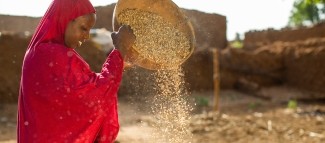
Chaudi Zakari winnows her cowpea harvest on her family’s farm in Tahoua Region, Niger, where the 12/12 Alliance project is working to increase production and provide access to markets for smallholder farmers. Photo by Jake Lyell for Corus International.
A series of crises in recent years has led to a steady deterioration in political, economic and social stability in Burkina Faso, Mali and Niger. Widespread and indiscriminate violence by armed groups, which has targeted civilians and public infrastructure, including churches, schools and hospitals, has increased political and social tension. More than 4,000 people were killed in 2019, making it the deadliest year on record for extremist violence.
In addition to the hardships posed by COVID-19, the region has also struggled with a series of climate-related hazards, including an increase in the frequency and intensity of flooding and drought. In recent months, the region was hit by torrential rain that caused flooding in Burkina Faso, Mali, Chad and Niger, impacting more than 700,000 people.
These multiple emergencies are driving what is becoming the world’s fastest growing displacement crisis. More than 3.5 million people have been forced from their homes, most of them internally displaced but with an increasing number of refugees.
In neighboring Côte d’Ivoire, opposition to the reelection of incumbent President Alasanne Ouattara has been met by outraged protests that have been met with a violent response, resulting in serious injuries and deaths.
Response: Corus International, through Lutheran World Relief, is working with farmers and agricultural organizations in the region, carrying out initiatives such as Relief to Resilience in the Sahel (R2R) in Mali and Sesame Marketing and Exports (SESAME) project in Burkina Faso to reduce poverty by improving farmers’ incomes. Two other Corus subsidiaries, IMA World Health and CGA Technologies, are working in Mali, helping it to broaden impact in the health and education sectors.
Venezuela and Venezuelan refugees
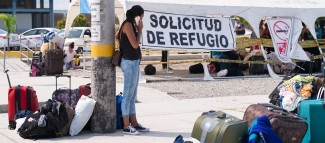
A view of the UNHCR tent at the border crossing in Tumbes, Peru, where Venezuelans can receive assistance in applying for refugee status. Photo by Morgan Arnold for Corus International.
Since 2015, 5.1 million Venezuelans have fled their country, escaping economic collapse and social insecurity that severely restricted access to food, health care and other essential services. Many left on foot, walking days and weeks to neighboring countries, most of which were initially welcoming, granting access to employment and education.
But life is becoming increasingly difficult for Venezuelan refugees, who are facing rising xenophobia and the challenges posted by COVID-19, including the high toll of the disease itself and the inability of families to access health and social welfare programs. The overwhelming majority of Venezuelan refugees depend on the informal economy for a living, with estimates ranging from 60 to 90 percent depending on the country, and the pandemic lockdowns are depriving them of a livelihood. Cramped living conditions make social distancing difficult, even as many families face eviction for lack of rent payments.
These challenges have triggered a reverse migration, with approximately 105,000 refugees returning to Venezuela from Brazil, according to the Organization of American States. These returnees have faced maltreatment and human rights violations, including the arbitrary closing of the Colombia-Venezuela border, limiting the number of people who can cross. President Nicolas Maduro has denounced the returnees as “bioterrorists” and has forcibly quarantined some in jail cells.
Response: Lutheran World Relief, a Corus International subsidiary, is working with local organizations in Peru to improve access to psychosocial and livelihood recovery services and to provide crucial COVID-19 information for Venezuelan refugees and migrants living there. Lutheran World Relief and its partners have been sending public health messages and other essential information to Venezuelan refugees through the VenInformado digital platform (accessible through Facebook, Instagram and WhatsApp), which also provides virtual resources for guidance on income-generating activities through links to online resources, including job referral services and vocational training tutorials.
Locusts in East Africa
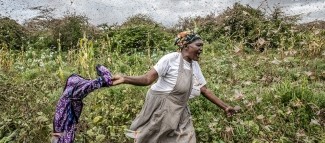
A woman attempts in vain to prevent a swarm of desert locusts from devouring crops and garden in Katitika village, Kitui county, Kenya. Photo by Sven Torfinn for ©FAO.
An invasion of desert locusts, the migratory pest that travels in swarms of millions and can daily eat its body weight in vegetation, caused widespread crop damage in East Africa and Yemen in 2019 and 2020, putting an estimated 20.2 million people at risk of severe acute food insecurity. Affected African countries include Ethiopia, Kenya, Somalia, South Sudan, Uganda and Tanzania.
Eradication efforts made a dent in reducing the threat, but according to the U.N.’s Food and Agriculture Organization, swarms are reforming in Somalia and have already crossed into Kenya, once again putting the region at risk.
The FAO warns that desert locust infestation “poses an unprecedented risk to agriculture-based livelihoods and food security in an already fragile region,” beset by consecutive shocks that include poor rainfall, flooding, macroeconomic crises and armed conflict.
Response: Corus International’s Lutheran World Relief provides support to farmers and farmer organizations across East Africa, helping them to improve agricultural practices and to run their farms as family businesses. IMA World Health supports public health and health system strengthening in the Democratic Republic of Congo, Kenya, South Sudan and Tanzania.
La Niña: A weather cycle exacerbated by climate change
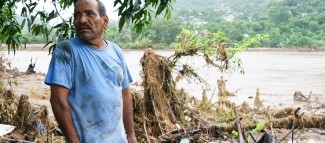
Rene Artuo Lopez Roques stands at the ruins of his house, destroyed by Hurricane Eta, along the Chamelecon River in San Pedro Sula. Photo by Greg Brekke for Corus International.
The climate phenomenon known as La Niña, the periodic cooling of ocean surface temperatures in the equatorial Pacific, developed in late 2020 and is expected to extend into early 2021. The opposite of the El Niño warming trend, La Niña generally leads to increased rainfall in Central and South America (with the exception of Uruguay and parts of Argentina), and decreased rainfall in East Africa, including Kenya and Somalia.
Researchers fear that the effect of the buildup of greenhouse gases could make both the La Niña and El Niño cycles more intense and more frequent. “Extreme El Niño and La Niña events may increase in frequency from about one every 20 years to one every 10 years by the end of the 21st century under aggressive greenhouse gas emission scenarios,” said Michael McPhaden, a senior scientist with the National Oceanic and Atmospheric Administration and co-editor of El Niño Southern Oscillation in a Changing Climate. “The strongest events may also become even stronger than they are today.”
As we saw with hurricanes Eta and Iota in Central America, the region may face strong storms and heavy rainfall that could lead to flooding and landslides leading to destruction of homes and infrastructure. The increased moisture could exacerbate destructive plant diseases, such as coffee leaf rust, harming the livelihood of farmers.
In East Africa, the La Niña effect could result in drought conditions, combined with the locust infestation, severely impacting food security.
Response: Lutheran World Relief, a Corus International subsidiary, works with communities in the Central American countries of El Salvador, Guatemala, Honduras and Nicaragua to help them prepare for disasters. In response to hurricanes Eta and Iota, Lutheran World Relief is working in San Pedro Sula, Honduras, providing cash grant support and addressing the need for urgent water, sanitation, hygiene and furnishing assistance aimed at returning laborers, famers and others affected by the disaster to their homes. A shelter-based psychosocial response supports those who experienced trauma during this emergency.
Central American forced displacement & migration
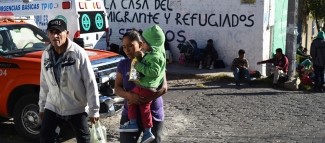
Asylum seekers in Tlaquepaque Jalisco, Mexico. Photo by Daniel Arauz. Licensed under CC BY 2.0.
The continuing crisis of governance and forced displacement in Central America has helped fuel migration to the U.S., which became a policy focus and political flash point during the last four years of the Trump Administration. In an attempt to severely limit the number of entrants, both legal and illegal, officials instituted draconian policies, such as severe restrictions on the ability to apply for asylum at the U.S.-Mexico border, the “remain in Mexico” policy that requires asylum seekers who arrive in the U.S. to stay in Mexico throughout their asylum process, and the practice of child separation.
The incoming Biden Administration will likely be tested as immigration analysts predict a substantial surge at the southern border of the U.S. in the coming months. One factor that could add to the northward migration is optimism over anticipated policy changes with the new Administration. Add to that the damage caused by hurricanes Eta and Iota, combined with the economic downturn associated with COVID-19 and the ongoing effects of climate change on agricultural production, all of which will increase pressure to migrate. The United Nations forecasts that hunger in Central America will rise dramatically due to the double hit of Covid-19 and hurricane damage, with the number of people suffering from severe food insecurity expected to nearly double to 3 million.
The Biden Administration has an opportunity to engage with Central American countries in a way that will yield sustainable and long-term impact through more focused and coherent diplomacy and assistance. This could include upholding humane and values-based displacement and migration policies towards the region. The U.S. should also use aid in a way that holds governments accountable for corruption, while increasing support for proven humanitarian, health and development programs at the local level, especially those targeting young people. And finally, the U.S. should include the impact of the climate crisis in planning with its Central American partners, including investments in disaster preparedness and risk reduction, as well as assistance that will help farmers adapt to climate changes that are decimating their harvests and forcing them to leave their farms.
Response: Corus International affiliate Lutheran World Relief works with small-plot farmers and their cooperatives, particularly those growing coffee and cocoa, to help them improve production and quality and gain greater bargaining power with buyers, with a particular focus on engaging youth. The response to hurricanes Eta and Iota focuses on San Pero Sula, Honduras, and includes distributing potable water, soap, sanitary items in shelters and household supplies for families returning to their homes. Longer term support includes livelihood recovery for farmers.
Progress threatened in reducing maternal and child deaths in sub-Saharan Africa
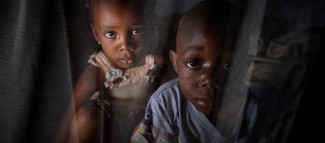
Two children sit under an IMA World Health-provided bed net treated with insecticide to prevent malaria in Goma, eastern Democratic Republic of the Congo. Photo by Paul Jeffrey for Corus International.
Globally, there has been considerable progress in reducing maternal and child deaths, with the mortality rate for children under five years old declining by nearly 60 percent in the last three decades. This good news comes with the caveat from UNICEF and the World Health Organization that major disruptions to health services stemming from the COVID-19 pandemic, including overtaxed health systems and fear of going to clinics, threaten to reverse decades of progress. “The global community has come too far towards eliminating preventable child deaths to allow the COVID-19 pandemic to stop us in our tracks,” said UNICEF Executive Director Henrietta Fore.
In addition, that progress has been uneven. Sub-Saharan Africa has the world’s highest rate of under-five child mortality, with 76 deaths per 1,000 live births, a rate 20 times higher than Europe and North America, which has 4 deaths per 1,000 live births. Sub-Saharan Africa, where 2.2 million children died in 2019 before reaching their fifth birthday, accounted for more than half of the world’s total, a milestone it reached for the first time in 2017. Infant mortality is higher in rural areas than in urban settings, largely due to the difficulty in accessing health care services and the lack of public infrastructure providing adequate water and sanitation.
Maternal mortality is a similar story. Maternal deaths declined in sub-Saharan Africa by 40 percent since 2000. But the region still accounts for approximately two-thirds of all maternal deaths globally. Almost all maternal deaths occur in the developing world, and more than half occur in fragile and complex humanitarian settings.
Response: IMA World Health, part of the Corus International family, leads the USAID-supported MOMENTUM Integrated Health Resilience project, a five-year initiative working to improve the health and well-being of women and children in fragile and conflict-affected settings globally. The aim is to improve the access to and availability of high-quality, respectful and person-centered maternal, newborn and child health services and voluntary family planning and reproductive health care in fragile and conflict-affected settings, and to increase the health resilience of families and communities. The MOMENTUM project is planning or already underway with activities in South Sudan, Mali, Democratic Republic of Congo and Burkina Faso.
Lebanon: Crisis on crisis
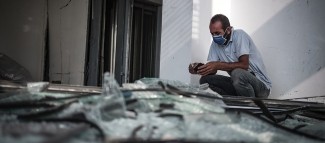
Aref al-Ali pores over the passport of his brother, who was killed in this room by the Aug. 4, 2020 blast in Beirut. Photo by Joao Sousa for Corus International.
Lebanon, the small but strategically important Middle Eastern nation, suffered crisis upon crisis this past year. It was experiencing the worst economic downturn of its modern history, with the economy and the labor market in near collapse even before the catastrophic twin explosions on August 4 rocked the Port of Beirut. The economic distress was exacerbated by strict lockdowns to limit the spread of COVID-19.
The nation’s leadership was shaky at best, with outsized influence from regional authoritarian neighbors in recent years, threatening the always restive balance among the three factions that share power in Lebanon: Shi'a and Sunni Muslims, and Maronite Christians. Six days after the port explosions, the national government resigned and subsequent attempts to form a new government have been unsuccessful.
Lebanon, with a population of more than 6 million, is host to more than a million refugees from neighboring Syria. The Syrians do not live for the most part in formal camps, but are scattered among 2,100 rural and urban communities, with more than 70 percent living below the poverty line, struggling for employment and often living in cramped housing.
An unstable Lebanon is a risk the global community can ill afford, especially in a Middle East region trying to find its way to peace and prosperity amid small and great power competition.
Response: In Lebanon, Corus International affiliate Lutheran World Relief has been providing disadvantaged Lebanese families and Syrian refugees with specialized agricultural training and employment opportunities, complemented by training in conflict resolution and prevention techniques, which helps stressed local and refugee communities learn to work together. An initial response to the Beirut explosions included food parcel distribution, which shifted to the provision of non-food items, such as kitchen appliances, as families returned to repair their damaged homes.
violence against women and girls: An ominous rise
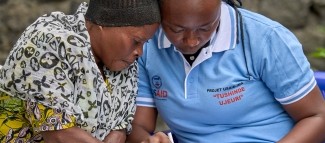
Chamsi Djuma, right, studies with her literacy tutor, Darlose Katungu, who has helped her to learn to read and write through the Tushinde project. Photo by Paul Jeffrey for Corus International.
violence against women and girls is a global scourge, occurring in all countries at all socio-economic levels, with at least 30 percent of women reporting at least one incident in their lifetimes. It has profound health implications, as women who have experienced violence against women and girls are more likely to acquire HIV, and are more susceptible to alcoholism and depression, in addition to the risk of injury and death.
Studies have also shown that violence against women and girls is more prevalent in developing countries, and is consistently higher in sub-Saharan Africa, as compared to other regions of the world, with 44 percent of women reporting an experience of intimate partner violence.
Conflict can also be a significant driver of violence against women and girls, especially against women and girls, including torture, killing, sexual violence as a tactic of war and forced marriage. There are often high levels of violence against women and girls in post-conflict situations, given the breakdown of social order, the availability of weapons, impunity and the normalization of such actions during conflict.
Although the data is preliminary, there are reports that the COVID-19 pandemic is exacerbating the problem of violence against women and girls. The economic and social stress caused by the restricted movement and isolation measures taken to limit the pandemic are contributing to escalating incidents, with increases of upwards of 25 percent, and a few countries reporting a doubling of cases.
Response: Corus International’s IMA World Health carries out the USAID-funded Counter-violence against women and girls Program (known locally in Swahili as “Tushinde Ujeuri”), which establishes community-based safe houses and supports community groups in eastern Democratic Republic of Congo to prevent and respond to sexual and violence against women and girls with the goal of reducing violence, resolving stigma and improving holistic care for survivors.